



You finish your revision. You know the theory. You can explain demand curves, evaluate fiscal policy, and define every term in the syllabus. Then your marked essay comes back, and the score does not reflect any of that. Sound familiar?
This disconnect between what a student knows and what they actually score is the defining frustration of H2 Economics. After 18 years of teaching at the A-Level, it is the pattern we see most often — and it is almost always a strategy problem, not a content problem.
Key Takeaways
- Knowing content is necessary but not sufficient. Examiner marks are awarded for how you respond, not how much you know.
- The three highest-leverage skills in H2 Economics are question decoding, evaluation execution, and time allocation.
- The best A level economics tuition programmes teach students to think like an examiner, not just revise like a student.
- Response strategy can be learned and drilled. It is not a natural talent reserved for top students.
Why “I Know The Content” Is Not Enough
Every year, students walk out of the H2 Economics exam convinced they performed well — only to receive a C or D. Their content knowledge was not the issue. What failed them was their response strategy: how they read the question, structured their argument, deployed evaluation, and allocated their time across the paper.
The H2 Economics exam (syllabus 9570) is not a content-recall test. It is a structured argument test that uses economic content as the raw material. Examiners are not rewarding students who know the most. They are rewarding students who communicate economic thinking most clearly and convincingly under time pressure.
This distinction changes how you should think about preparation entirely.
The Four Layers of H2 Economics Response Strategy
1. Question Decoding — The Step Most Students Skip
The single most costly habit in H2 Economics is beginning to write before fully understanding what is being asked.
Every essay question contains at least three layers of information:
| Layer | What to Identify | Example |
| Command word | What type of response is required | “Evaluate” ≠ “Explain” ≠ “Discuss” |
| Economic concept | Which theory or mechanism is being tested | Fiscal policy, price elasticity, and externalities |
| Scope or context | Any restrictions on your argument | “In the context of a small, open economy like Singapore” |
Misreading a command word alone can cost a student an entire mark band. An “evaluate” question demands a reasoned judgement with trade-offs weighed. An “explain” question does not. A student who answers an “evaluate” prompt with description-only responses — even an accurate, well-written description — will be capped at Level 2 regardless of content quality.
Spending 2 to 3 minutes decoding the question before writing is not wasted time. It is the highest-return investment in the entire exam.
2. Essay Architecture — Structure That Signals Thinking
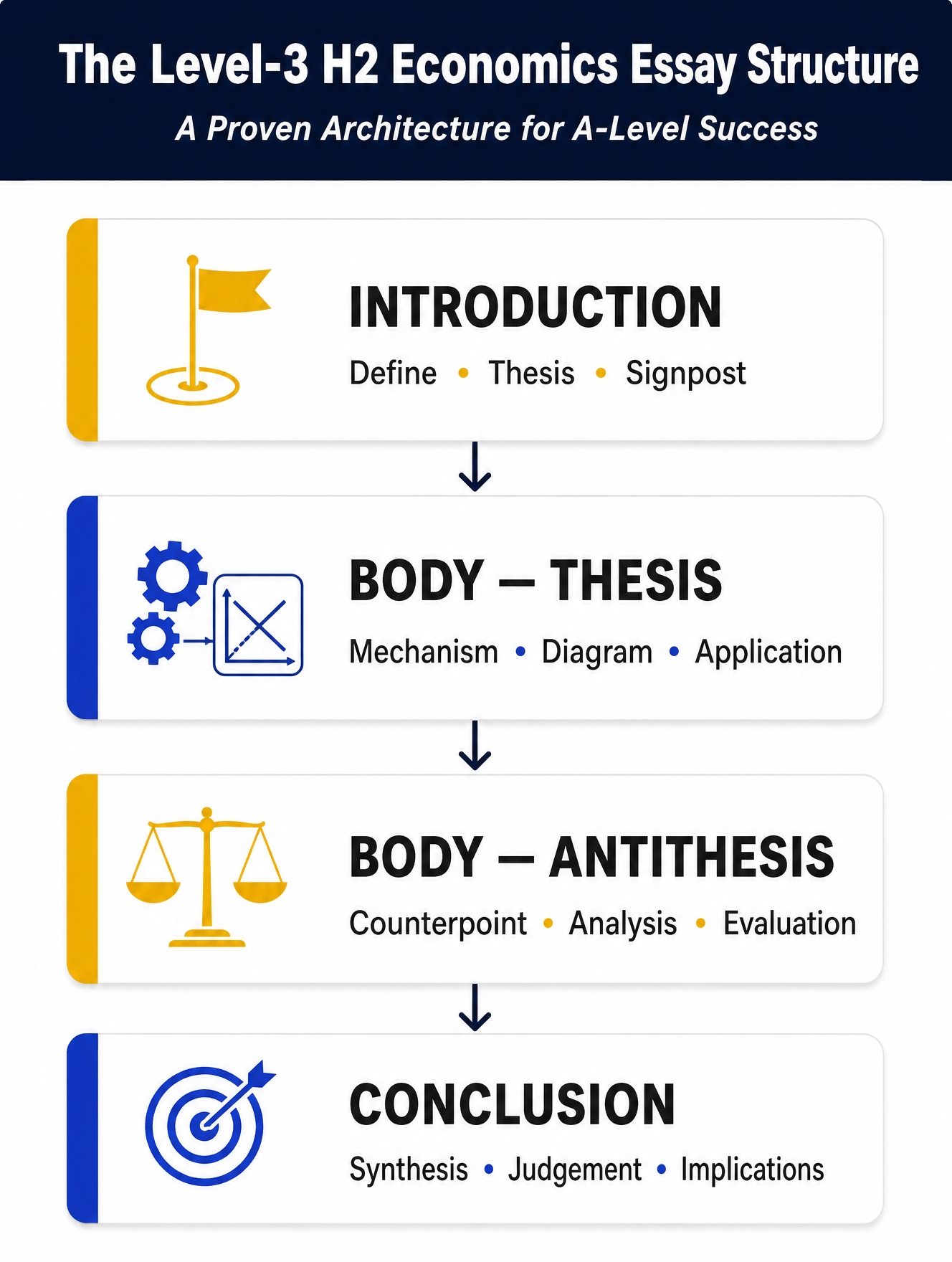
A common misconception is that a well-written essay just needs good points. In reality, how those points are organised signals to the examiner whether the student is thinking economically or simply recalling information.
A Level-3 H2 Economics essay follows a consistent architecture:
Introduction → Define key terms, state a clear thesis, signal the argument structure
Body (Thesis paragraphs) → Economic mechanism explained with precision; diagram integrated where relevant; real-world application (Singapore-specific where the question demands it)
Body (Evaluation paragraphs) → Conditions under which the argument holds or breaks down; short-run vs long-run distinctions; country-context qualifications
Conclusion → A direct, reasoned judgement — not a summary of both sides, but a position defended by the weight of the preceding argument
Writing “this policy may not be effective due to limitations” is a placeholder, not an evaluation. Genuine evaluation identifies the specific condition that changes the outcome and explains why it matters in the given context.
A quick benchmark: In a 25-mark essay, you should have at least four to six distinct evaluation points woven through your body paragraphs — not gathered in a single concluding paragraph as an afterthought.
3. CSQ Technique — A Different Skill Set, Often Neglected
Paper 1 Case Study Questions account for 40% of the H2 Economics grade. Yet many students treat CSQ preparation as secondary to essay practice.
CSQs test a different skill set. The key difference is that your argument must be anchored to the data provided, not just grounded in economic theory.
The most common CSQ errors, and how to correct them:
| Common Error | Why It Costs Marks | The Fix |
| Ignoring the extracted data | Answers read as a generic theory, not responses to the case | Always reference the extract explicitly: “Extract 2 shows that…” |
| Over-writing short questions | Wastes time; gets no additional marks | Match the answer length to the mark allocation strictly |
| Weak higher-order responses | The 8–10 mark questions require essay-level analysis | Treat high-mark CSQ questions as mini-essays with the same evaluation discipline |
| Running out of time | The final question is left incomplete or rushed | Allocate time strictly; practise abandoning a question at the right moment |
The 8-mark and 10-mark CSQ questions are, in effect, essay questions in disguise. Students who have mastered essay evaluation almost always outperform those who have not, even on CSQs. The skills transfer directly.
4. Time Allocation — The Strategic Resource Most Students Waste
H2 Economics Paper 2 gives students 2 hours and 30 minutes to write three essays of 25 marks each. That is 50 minutes per essay. Within each essay, a student must plan, develop a thesis, evaluate, and conclude.
Most students violate their own time budget on the first essay. They write longer than planned because the topic feels familiar. Then, they scramble through the second and third, producing rushed, incomplete work.
It is almost always easier to earn the first 10 marks of an unfinished essay than to squeeze the final marginal marks out of an essay that is already at 18/25. Leaving an essay incomplete is one of the most damaging things a student can do to their grade.
Strict time discipline is a trainable habit. Practising under timed conditions and committing to moving on when time is up, even when an essay feels unfinished, builds the exam stamina that separates A-grade students from those who plateau at B or C.
What Good H2 Economics Tuition Actually Teaches
The difference between tuition that produces results and tuition that merely delivers content is this: the best programmes teach students to think in response frameworks, not just absorb information.
That means:
- Every lesson practices question decoding, not just content coverage
- Model essays are dissected for why they score, not just read as examples to copy
- JC economic tutor’s feedback on written work is examiner-specific, pointing to the exact line where marks were lost and why
- Students write under timed conditions regularly, not only in the weeks before the exam
At ThatEconsTutor, our Parachute Concept Approach is built precisely around this principle. Students are taught to see the full landscape of the syllabus, including how micro and macro topics connect, how questions are constructed, and how the examiner’s mark scheme rewards different levels of response — before drilling into the details of any single topic. The result is that students stop writing what they know and start writing what earns marks.
With 80% of our students scoring A or B in recent A-Level sittings, the evidence is clear: a response strategy taught systematically produces results faster than content revision alone.
A Practical Self-Assessment: Where Is Your Strategy Breaking Down?
Before your next practice essay, run through this checklist:
- Did you spend at least two minutes decoding the question before writing?
- Does your introduction state a clear thesis — not just define terms?
- Does each body paragraph contain explicit evaluation, not just analysis?
- Is every CSQ answer anchored to a specific extract or data point?
- Did you finish all the required questions within the time limit?
If you answered no to two or more of these, your priority is not more content revision. It is strategy work — and that is precisely what targeted A level econs tuition is designed to fix.
The Best H2 Economics Tuition Teaches You to Think Like an Examiner
Content knowledge is the price of admission to H2 Economics. It gets you into the exam. Response strategy is what determines where you land once you are there.
The students who consistently achieve distinction do not necessarily know more than their peers. They write more precisely, structure their arguments more deliberately, and manage their time more strategically. These are skills that can be taught, practised, and refined.
If your revision has been content-heavy but your scores don’t reflect it, the gap is almost certainly in how you are responding to questions. Goodeconomics tuition with an experienced JC economics tutor closes that gap faster than self-study alone because the feedback loop is immediate, the frameworks are proven, and the practice is purposeful.Get a trial lesson at ThatEconsTutor and find out what a strategy-first approach to H2 Economics actually feels like in the classroom.