



Choosing the right economics tuition format is one of the most important decisions a JC student can make, yet it rarely gets the attention it deserves.
Over my 18 years of teaching H2 Economics in Singapore, I’ve seen students thrive or struggle not because of the content, but because of the learning environment they were placed in.
The format you choose affects how consistently you revise, how much individual attention you receive, and ultimately how confidently you walk into the A-Level examination hall.
Let’s break down the three formats of Economics Tuition in Singapore to find which fits you best.
Key Takeaways
- The three main economics tuition formats in Singapore are small-group, hybrid (online + onsite), and intensive revision programmes.
- No single format suits every student. The right choice depends on your learning style, schedule, and stage of study.
- Hybrid tuition offers the most scheduling flexibility without sacrificing the structure of live instruction.
- Intensive revision is most effective when students already have a content foundation; it is not a substitute for consistent year-round study.
Why Format Matters as Much as Content
Most students compare econ tuition centres by looking at a tutor’s credentials, class size, or pass rates. Don’t get me wrong. All of that matters. But the format — how, when, and where you learn — is what determines whether you can actually sustain the pace.
Singapore’s A-Level Economics syllabus (H2 and H1) demands both content mastery and sharp application skills. Essays require structured economic arguments backed by real-world evidence; case study questions demand accurate data interpretation under time pressure.
These skills are built incrementally, not overnight. Which is exactly why the format you choose now will shape how well-prepared you are come October.
The Three Main Tuition Formats Explained
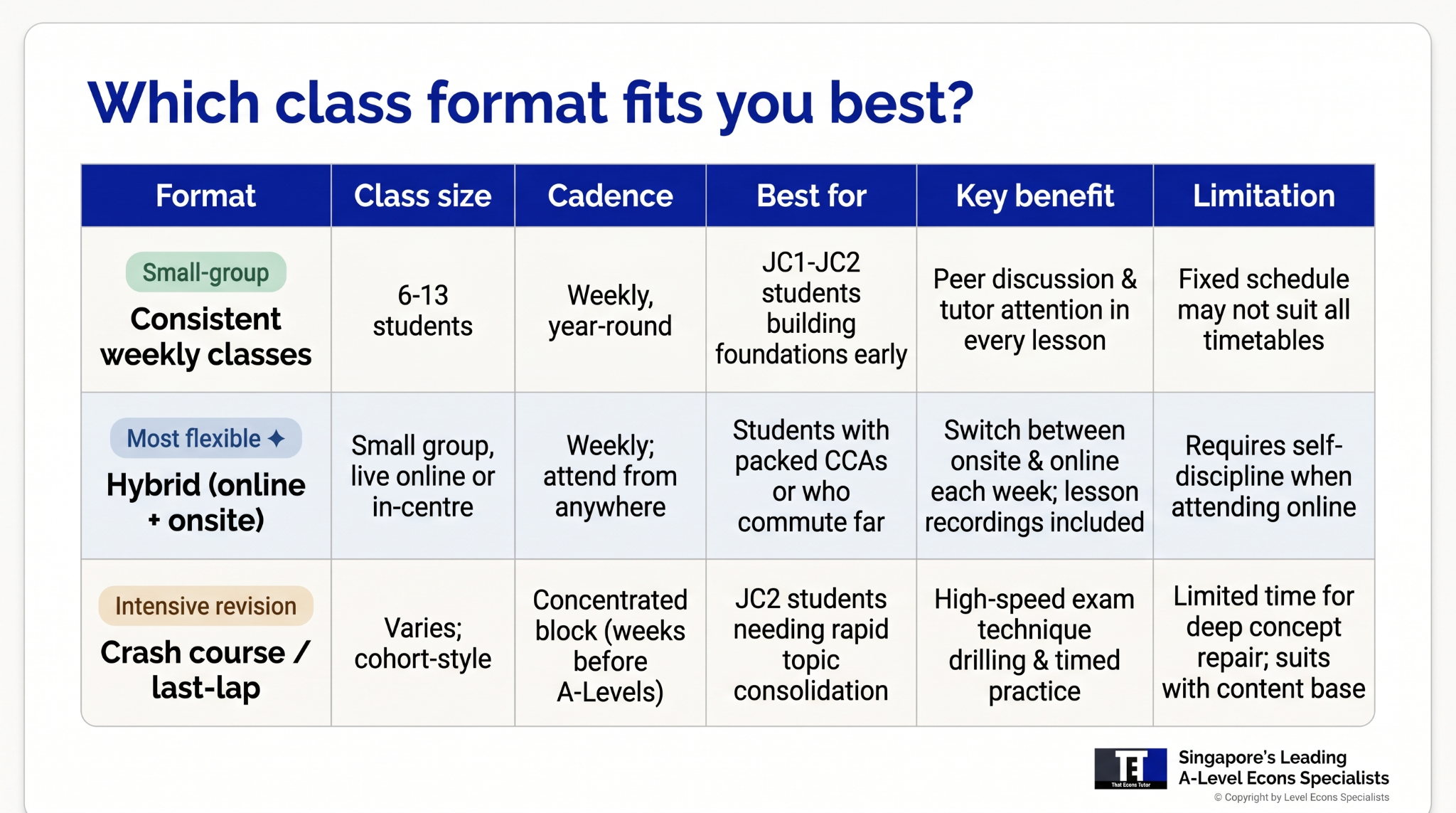
Small-Group Tuition
Small-group tuition typically runs in classes of 6-13 students, meeting weekly throughout the JC calendar year. It strikes a balance between structured teaching and tutors’ ability to address individual questions during and after each lesson.
In well-run small-group classes, lessons follow a deliberate sequence:
- Concept instruction to introduce or reinforce the topic
- Worked examples that model how to apply theory to exam questions
- Timed practice to build speed and writing discipline
Students also benefit from hearing how peers approach problems differently, which sharpens critical thinking in a way that solo study cannot replicate.
This format suits JC1 and early JC2 students who need to build a strong conceptual foundation and develop essay-writing habits over time. It is less effective for students who join late in the year with significant content gaps, as the class moves at a pre-set pace.
Hybrid Tuition (Online + Onsite)
Hybrid tuition has become the standard at forward-thinking economics tuition centres in Singapore. Students can attend lessons physically at the tuition centre or join the same live class via video link — and switch between the two from week to week based on their schedule.
At ThatEconsTutor, all JC Economics classes run in a fully hybrid format across our Bukit Timah and Goldhill Plaza centres, with lesson recordings provided after every session. In practice, this means:
- Students never miss content due to school events, CCA clashes, or illness
- Recordings allow for targeted replay of tricky concepts before exams
- Onsite and online students participate in the same live class, not separate tracks
The flexibility of hybrid tuition is particularly valuable for JC2 students managing multiple A-Level subjects simultaneously. It removes the all-or-nothing dilemma that weekly fixed-venue classes create.
Hybrid tuition requires a degree of self-accountability when attending online. Students who find it easy to get distracted at home should consider attending onsite more often, treating the online option as a backup rather than the default.
Intensive Revision Programmes (Crash Courses)
Intensive revision programmes — often called crash courses or last-lap programmes — are concentrated blocks of tuition designed to cover large swaths of the syllabus in a short period, typically in the weeks leading up to Preliminary examinations or the A-Levels themselves.
A well-structured intensive programme typically covers:
- High-yield essay themes most likely to appear in the A-Level paper
- Case study data interpretation techniques under timed conditions
- Common examiner pitfalls and how to avoid them in both essays and CSQs
These programmes are most valuable for students who already have a reasonable content base and need to consolidate knowledge and sharpen exam technique.
However, intensive revision is not a shortcut for students who have not been studying consistently. If foundational concepts are unclear, cramming them in a week-long block will not produce lasting understanding. In those cases, students are better served by starting regular tuition earlier, even if it means joining a new centre partway through the year.
How to Choose: Four Questions to Ask Yourself
Here are four questions I ask students and parents before suggesting the right format for them.
- How much of the syllabus have I already covered? If you are JC1 or early JC2 with significant gaps, start with small-group or hybrid tuition immediately. Intensive revision alone will not fill deep conceptual holes.
- How predictable is my weekly schedule? If your schedule is consistent and you can commit to a fixed time slot, a small group works well. If school activities, sports, or family commitments make every week different, a hybrid is the smarter choice.
- How close are the A-Levels? If you have four to six months remaining, the a level economics tuition guide for 2026 shows why regular weekly tuition should still be the priority. If you have four to eight weeks left and your foundations are solid, an intensive revision programme can provide the last push in exam technique and essay precision that makes the difference between a B and an A.
- Do I learn better with peer discussion or independent review? Small-group and hybrid formats naturally involve peer interaction. If you are the type who benefits from hearing different approaches discussed in class, either works well. If you prefer to absorb content at your own pace after the live lesson, the hybrid’s recording feature is particularly useful.
A Note on Combining Formats
Many students in Singapore combine formats across their JC journey. A common approach is to attend regular weekly tuition in JC1 and early JC2 (small-group or hybrid), then supplement with an intensive revision programme in the final months before A-Levels.
This layered approach of gradually building concepts, then intensively sharpening exam application, is one of the most effective strategies I have seen produce consistent A and B grades.
The key is not to treat an intensive programme as a replacement for year-round study, but as a structured endpoint to a revision process that began much earlier.
Economics Tuition in Singapore is for All
If you are starting early and want consistent, progressive learning, small-group or hybrid tuition will serve you best. If you are in the final stretch with a solid content base, an intensive revision programme can significantly sharpen your edge. And if you want the flexibility to do both without disrupting your schedule, hybrid tuition gives you that without compromise.
At ThatEconsTutor, our JC Economics tuition runs in a fully hybrid format across both our Bukit Timah and Goldhill Plaza centres, with JC1, JC2, and intensive crash course options available.
If you are unsure which format fits your current stage and goals, you are welcome tostart with a trial lesson and experience the approach for yourself before committing.