



After more than 18 years of guiding JC students through A-Level Economics, it’s clear that most students don’t fail because they lack knowledge. They fail because they lack a strategy.
Paper 1 and Paper 2 test very different skills, and conflating them is one of the costliest mistakes I see in the exam hall.
For students looking for JC Economics tuition, this guide breaks down exactly what each paper demands and how to prepare for both.
Key Takeaways
- Paper 1 rewards speed and precision. Learn to read selectively and structure short answers with economic logic, not essays in disguise.
- Paper 2 rewards depth and evaluation. Examiners at the L3 band want judgements, not just well-organised lists of theory.
- Master your command words. A student who misreads “evaluate” as “explain” loses marks before writing a single sentence.
- The Singapore context is non-negotiable. Many questions are rooted in the local economy; generic textbook answers alone will not secure distinction.
Understanding the A-Level Economics Exam Structure
Before building a revision plan, you need to understand precisely what you are up against. The H2 Economics exam (syllabus 9570) comprises two papers of equal weighting. Students looking for H2 Economics tuition often benefit most when they first understand this split clearly.
| Paper 1 — Case Study Questions (CSQ) | Paper 2 — Essay Questions | |
| Duration | 2 hours 30 minutes | 2 hours 30 minutes |
| Marks | 60 marks | 75 marks |
| Format | 2 compulsory case studies | 3 essays from 6 (min. 1 from each section) |
| Marks per question | 30 marks each | 25 marks each |
| Weighting | 40% of the total grade | 60% of the total grade |
| Key skills tested | Data interpretation, application, analysis | Conceptual depth, structured argument, evaluation |
For H1 Economics (syllabus 8843), students sit one 3-hour paper with two compulsory case studies, each worth 45 marks.
Mastering Paper 1: Case Study Questions
What Paper 1 Is Actually Testing
Many students approach Paper 1 as though it were Paper 2 in disguise — writing long, flowing arguments when the examiner wants focused, evidence-anchored responses.
Unlike subjects where students can rely heavily on memorisation, Economics requires quick thinking, data interpretation, and precise application of theoretical knowledge within strict time limits.
The case study extracts are your evidence base. Use them.
The Five Question Types You Must Recognise
There are five types of questions that can appear in a JC Economics case study exam paper. Knowing which type you are answering changes how you structure your response entirely:
| Question Type | What It Requires | Common Error |
| Trend analysis | Describe movement over time | Describing absolute levels instead of rates of change |
| Comparison | Identify one similarity and one difference | Listing two similarities (no comparison is made) |
| Explanation | Link data to economic theory step-by-step | Generic theory without referencing the extract |
| Application/analysis | Apply a concept to the given context | Ignoring the case study context entirely |
| Evaluation (HOQ) | Form a justified judgement | Restating analysis instead of weighing evidence |
Time Management For Paper 1
Students who underestimate reading time often struggle with time management. They spend too long on 4–5 mark questions, writing essays rather than concise, structured answers, ignoring the data provided in the extracts, forgetting the diagrams, and failing to provide evaluation in 8–10 mark questions.
A practical time allocation:
- Reading + marking up extracts: 8–10 minutes per case study
- Per mark, writing time: approximately 2 minutes
- A 4-mark question should take ~8 minutes; a 10-mark question, ~20 minutes
The Paper 1 Approach That Works
From our lessons at ThatEconsTutor, students are trained to read case studies strategically, not linearly. We advise them to scan for economic keywords, annotate data trends, and flag which extracts are likely to be used before reading the questions.
Graphs, tables, and charts often cause students stress, but a top tutor teaches them to interpret them, helping them understand why the numbers matter and how to use them in their answers.
Mastering Paper 2: Essay Questions
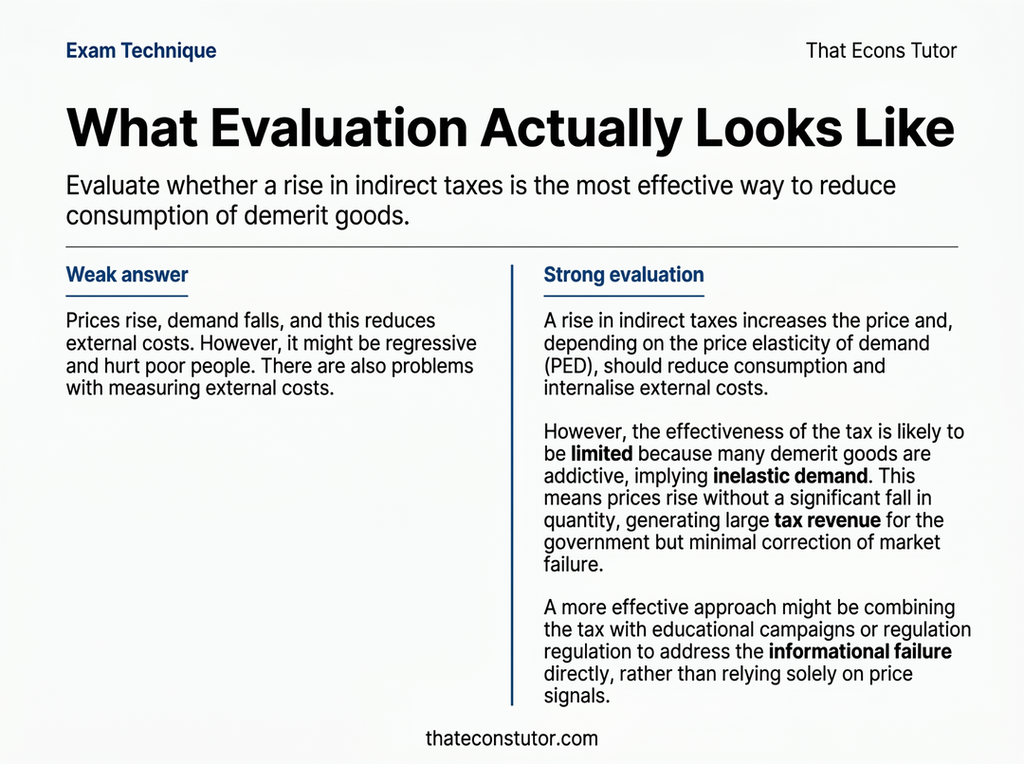
What Separates an A from a C
Paper 2 carries 60% of your final grade. This is one reason many students seek H2 Econs tuition when they realise how much the essay paper determines the final outcome.
The Evaluation component is a key element in Paper 2, worth 15 out of 75 marks (20%), requiring higher-order thinking to form well-justified conclusions.
Most students lose marks not in their analysis, but in their evaluation. Writing “this policy may not work because of limitations” is not an evaluation —it is a placeholder. Evaluation means weighing evidence, considering context, and arriving at a reasoned judgement.
Decoding Command Words — The Make-Or-Break Skill
| Command Word | What the Examiner Wants |
| Explain / Account for | Economic logic, cause-and-effect chain, diagram where relevant |
| Discuss | Both a thesis and an antithesis — balanced argument |
| Evaluate / To what extent | Judgement with supporting reasoning; consider limitations and alternatives |
| Assess | Similar to evaluating — weighing the merits and drawbacks, then concluding |
Read the prompt carefully. Identify the command words (e.g., “explain”, “discuss”, “evaluate”) and the context. For example, whether the question is Singapore-specific or global. Many students begin writing before fully parsing the question. That is a costly habit.
Structuring Your Paper 2 Essay
With 25 marks and 45–50 minutes per essay, structure is everything. For students who are still not very proficient in writing, spending five minutes to craft an essay outline will be extremely useful in helping you write as clearly and concisely as possible.
By planning out the content points in your essay, you will have an easier time crafting it, as opposed to coming up with the points as you go.
A high-scoring H2 essay structure follows this pattern:
Part A (10 marks) — Knowledge, Application, Analysis
- Define key terms precisely
- Explain the mechanism using economic theory
- Support with a labelled diagram where relevant
- Apply to the specific context given in the question
Part B (15 marks) — Analysis + Evaluation
- Extend your argument with a second or third angle
- Introduce an alternative view or policy
- Weigh the arguments: what depends on assumptions? What is Singapore-specific?
- Conclude with a clear, justified position
The Singapore Context Requirement
This is the single most underrated element of Paper 2 preparation. Many essay questions are grounded in Singapore’s economic reality, such as the MAS’s exchange rate policy, supply-side fiscal measures, and open-economy constraints. Failing to apply theory to the local context results in losing marks.
Students who can seamlessly reference MAS policy, Singapore’s budget stance, or the structure of our small, open economy consistently outscore those who rely on generic theory.
The Strategic Revision Framework
One of the most effective Paper 2 strategies is selecting a topic. For Paper 2, candidates face six essay topics but only need to answer three: one from Section A, one from Section B, and a final one from either section. This means focusing on four topics across both sections is the most efficient strategy.
By specialising in two topics from Section A and two from Section B, candidates cover enough ground to confidently handle Paper 2.
This is a resource-allocation exercise, appropriate for an Economics exam.
| Revision Priority | What to Focus On |
| 4 core topics | 2 micro (e.g. market failure, market structures) + 2 macro (e.g. fiscal policy, growth) |
| 1 backup topic | Acts as a safety net if a question is unexpectedly difficult |
| CSQ practice | 1–2 timed full case studies per week in the final 8 weeks |
| Essay outlines | Daily — under timed conditions, not just reading model answers |
Common Mistakes That Cost Marks
From years of marking student scripts, these are the most frequent errors I see, and all of them are avoidable:
In Paper 1:
- Writing essay-style answers for 2–4 mark questions
- Ignoring data in the extracts and substituting a generic theory
- Not interpreting percentage changes correctly (confusing level with rate of change)
- Forgetting to include diagrams when prompted
In Paper 2:
- Beginning to write without identifying the command word
- Providing analysis in Part B without any evaluation or judgment
- Writing the same point twice with different phrasing
- Leaving out the Singapore context when it is clearly implied by the question
JC Economics Tuition That Prepares You for Both Papers
Acing both Paper 1 and Paper 2 in A-Level Economics comes down to a clear understanding of what each paper tests, disciplined practice under exam conditions, and the ability to apply economic theory to real-world and Singapore-specific contexts.
Knowledge alone is never enough. It’s the strategy, structure, and evaluation that separate distinction from a pass.
At ThatEconsTutor, our JC economics tuition programme is built around exactly these principles. Through our proprietary Parachute Concept Approach, students develop the big-picture framework to connect micro and macro topics, write L3-standard essays consistently, and enter the exam hall with genuine confidence.
With over 80% of our students achieving A or B in recent years, the methodology works.
For students who want a structured path from content knowledge to exam execution, JC Econs tuition can make that difference.
If you are ready to stop hoping and start performing,book a trial lesson with ThatEconsTutor — and experience the difference that structured, expert JC economics tuition makes.
Frequently Asked Questions
Students should look for tuition that prepares them differently for the distinct demands of both papers.
A strong programme should help students:
- interpret case study extracts efficiently
- structure essays clearly
- improve evaluation depth
- manage exam timing effectively
- handle unfamiliar contexts confidently
At TET Economics, lessons are designed around actual exam execution rather than passive content revision.
H2 tuition helps students develop:
- structured analytical thinking
- faster question interpretation
- stronger explanation techniques
- clearer evaluation
- better time management
Students are guided through:
- essay planning frameworks
- case study annotation methods
- data interpretation techniques
- argument sequencing strategies
This improves both accuracy and confidence under exam conditions.
Paper 1 focuses heavily on:
- case study interpretation
- extracting and analysing data
- concise explanation
- application under time pressure
Paper 2 requires:
- broader analytical depth
- sustained essay structure
- stronger evaluation
- more complex argument development
At TET Economics, students are trained separately for the unique demands of each paper while learning how concepts overlap across both.
Case study performance improves when students learn:
- how to identify question requirements quickly
- how to extract relevant information from extracts
- how to apply concepts precisely
- how to answer concisely under time pressure
At TET Economics, students practise:
- annotation techniques
- structured answering methods
- common case study question types
- time-management drills
This helps students become more systematic and efficient during exams.
Yes. Essay structure and evaluation are often key differentiators between mid-tier and distinction-level scripts.
Tuition helps students:
- organise arguments more logically
- sequence points clearly
- write deeper evaluation
- avoid repetitive or generic conclusions
- improve coherence and flow
At TET Economics, students are taught frameworks that make essays more structured, balanced, and examiner-friendly.
Students benefit most when they start before major weaknesses accumulate.
Early preparation allows students to:
- strengthen conceptual foundations
- refine answering techniques gradually
- build confidence steadily
- avoid last-minute cramming
However, targeted revision programmes ca